AI for Hospitality: 10 Tools That Take Work Off Your Hotel Team (2027)
AI in hotels has moved past answering questions. The tools that matter in 2027 do the work: they read the booking, draft the proposal, run the morning checks and wait for a person on anything that matters. Here is what that looks like, which tools to know, and how to choose.
 Venli Team·22 Oct 2026·22 min read

A hotel never stops asking things of its team. A guest wants to move their stay at 23:40. A wedding planner needs a quote for 80 people by Friday. The night audit finds three folios that do not balance. A group of German guests asks about parking in German. Every one of these lands on a team that is smaller than it was five years ago and busier than it has ever been.
That is why AI has gone from an experiment to part of how hotels run. Hotels now use it for guest messaging, phone calls, group sales, pricing, reporting and the checks nobody has time for. The hotels getting real value from it share one thing: their AI is connected to the systems the hotel already runs, and it does work rather than just talking about it. This guide explains how to get there.
Summary
- Adoption has outrun strategy. 78% of hotels use AI, yet 78% have no formal AI strategy and 72% have no dedicated AI budget.1 That gap is why some hotels save hours every day while others just add another login.
- The money is already moving. 85% of hotels will put at least 5% of their IT budget into AI this year, and 82% expect their AI use to grow over the next 12 months.2
- Answering is not the same as doing. A chat assistant that replies "late check-out is possible" has moved the work, not removed it. AI agents that read and write to the PMS finish the job.
- Control decides adoption. 53% of hotels already use AI to support pricing, but only 10% would let it make most pricing decisions.3 Hotels hand AI the work when they can set what it may do, approve what matters and see what it did.
- The best returns come from high-volume, low-risk work. The reservations inbox, group enquiries, the morning briefing and the night audit are where hours come back fastest.
- Connected beats clever. AI without access to reservations, room status and the hotel's own rules creates work for staff. AI with that access becomes part of the team.
- Venli brings it together. Venli is an agent management system: one place to build, run and govern AI agents on top of the PMS, inboxes, CRM and channels a hotel already uses, with nothing migrated.
Why hotels are investing in AI faster than ever
Guests now expect quick answers on whatever channel they choose, in their own language, at any hour. Planners expect a proposal the same day. Owners expect the same results from a leaner team. Hotels cannot meet all three by hand, and that gap between what is expected and who is available to do it is what is driving adoption.
Key pointAI adoption in hotels is not driven by curiosity. It is driven by the distance between rising expectations and the number of people on shift.

What pressure are hotel teams under every day?
Watch a front desk at 16:00. Check-ins are queuing, the phone is ringing, WhatsApp messages are stacking up, an OTA message asks about cots, and someone from housekeeping needs to know which rooms are priority. Behind the desk, the reservations inbox holds forty emails, most of them asking things the PMS already knows. Staff answer the same questions about parking, breakfast times and check-out all day, and every one of those answers takes time away from the guest standing in front of them.
Why do slow replies cost more than they look?
A guest who asks for late check-out at 10:00 and gets an answer at 13:00 has already packed. A planner who sends an enquiry on Monday and gets a proposal on Thursday has already signed with the hotel down the road. Delay is not only a service problem. In sales and events it is lost revenue, and it happens most in exactly the busy weeks when the hotel can least afford it.
Why do hotels miss revenue they already have?
Most hotels have more revenue in their inbox than they realise. Group enquiries sit unanswered because the sales manager is on site visits. Options on function rooms expire without a follow-up. Proposals go out and nobody notices they were never opened. Events are delivered and not invoiced for weeks.
None of this is for lack of effort. It is that the work between systems, copying an enquiry into the CRM, checking space, pricing the menu, chasing the client, is slow, manual and easy to drop when the week gets busy.
How do disconnected systems slow everyone down?
A typical hotel runs on a dozen systems: a PMS, Outlook or Gmail, a CRM, WhatsApp, a booking engine, a POS, a channel manager and a handful of spreadsheets. The work between them is people copying things across. Housekeeping status lives in one place, guest messages in another, group business in a third and revenue data in a fourth. Every handover is a delay and a chance for something to be missed.
Will AI replace hotel staff?
This is the worry that slows adoption most, and it is the wrong frame. Hospitality is a people business, and guests notice when it stops feeling like one. Good AI takes the repeatable work off the desk, the lookups, drafts, checks and reports, and hands anything unusual to a person with the context attached.
How does AI give staff time back for guests?
When the inbox drafts its own replies from the booking, the reservations team reviews and sends instead of typing. When the morning briefing writes itself from the PMS, the front office manager starts the day with VIPs, arrivals and open balances already flagged. When group enquiries arrive with a draft proposal attached, the sales team spends its time with clients rather than with spreadsheets. The time that comes back goes to the guests in front of them. To see how, it helps to be clear about what hotel AI tools actually are.
What are AI tools for hotels?
AI tools for hotels are software that uses large language models and machine learning to handle work that used to need a person: reading and answering messages, understanding requests, pulling data from hotel systems, pricing, forecasting and preparing documents. The useful ones connect to the PMS, the inboxes and the CRM, so they can act on real reservation data rather than guessing.
Key pointThe line that matters in 2027 is not "AI or no AI". It is whether a tool can only talk, or whether it can also do the work in your systems, under your rules.
How are AI agents different from chatbots?
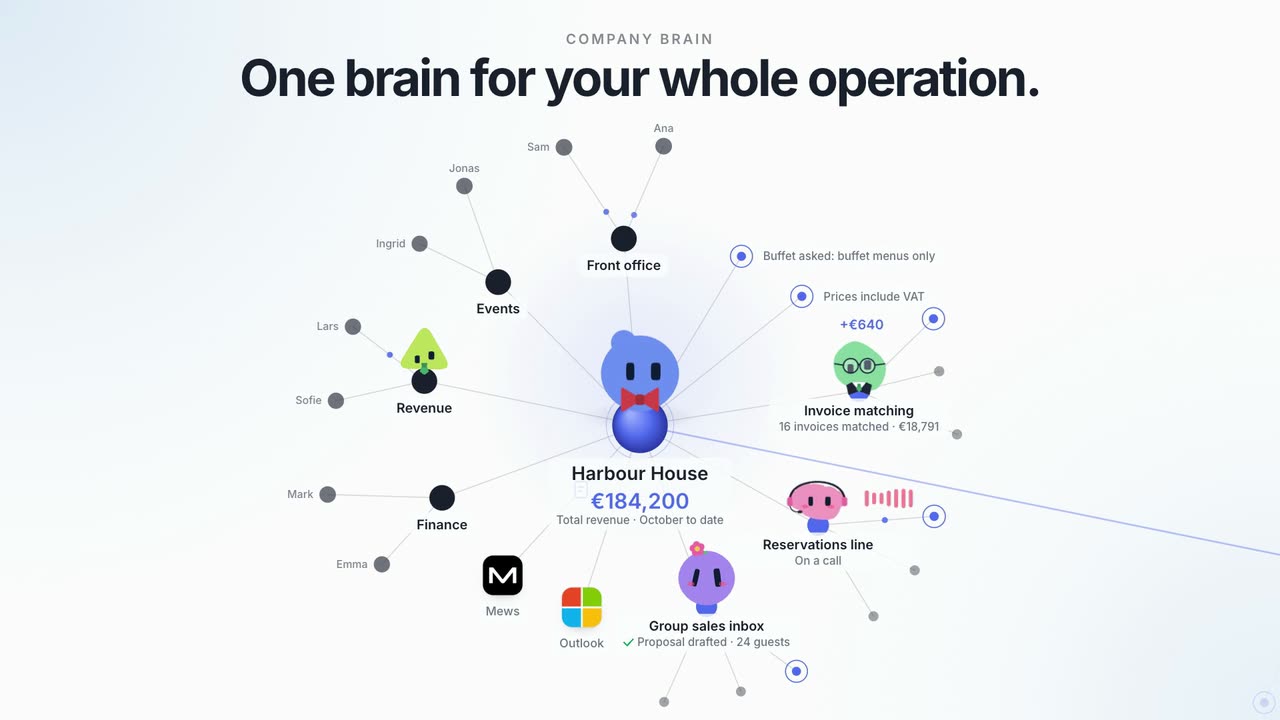
A chatbot answers questions from a script or a knowledge base. An AI agent understands what is being asked, looks up the booking, checks availability, prepares the change and the reply, and asks a person to approve when the rules say so. Take a guest on WhatsApp who wants to stay one more night. A chatbot says "please contact reception". An agent checks the room is free, prices the extra night, prepares the booking change and the reply as one card, and the reservations agent approves both with one click.
What is an agent management system?
Once a hotel runs more than one or two agents, it needs somewhere to manage them. An agent management system is that place. It connects agents to the hotel's systems, gives them the hotel's knowledge, runs the work, and decides what each agent may do. You can compare it to a PMS: a PMS manages rooms and reservations, and an agent management system manages the AI agents that work on them.
How does AI move hotels from reacting to preparing?
Hotel systems have always recorded what happened. AI can look across them and tell the team what needs attention before anyone asks. A daily briefing can show yesterday's business, today's arrivals with special requests, rooms with open balances and no card on file, and group options that expire this week. The night audit can flag folios that do not balance and rates that do not match the contract before the morning shift starts.
What can AI prepare beyond pricing?
Revenue management was the first place hotels used algorithms, but the same thinking now runs elsewhere. Agents can match supplier invoices to orders, chase missing rooming lists from groups, turn guest messages into housekeeping tasks, and draft the shift handover from the logbook. Each one is small. Together they are hours a day.
How does AI handle routine guest questions?
Most guest questions repeat: parking, breakfast, check-in times, pets, cots, late check-out, directions. They arrive on email, WhatsApp, SMS, web chat, OTA messaging and the phone, often all at once. AI that answers from the hotel's own knowledge and the live booking can handle these on every channel and hand the rest to a person.
What happens when AI handles the routine messages?
Staff stop retyping the same answers and start handling the conversations that need judgment: complaints, special occasions, complex groups. With email, replies start as drafts a person reads and sends, so the team stays in control while the typing disappears. When a person replies in a thread, the AI steps back on that thread until someone hands it back.
Why does system integration matter so much?
An AI that cannot see the reservation cannot answer "is my room ready?" An AI that cannot write to the PMS cannot move a booking. Integration is what turns AI from another inbox to watch into part of the operation. That means reading and writing through the PMS's own API, with the PMS staying the system of record and nothing migrated.
Why does setup take months with some tools and days with others?
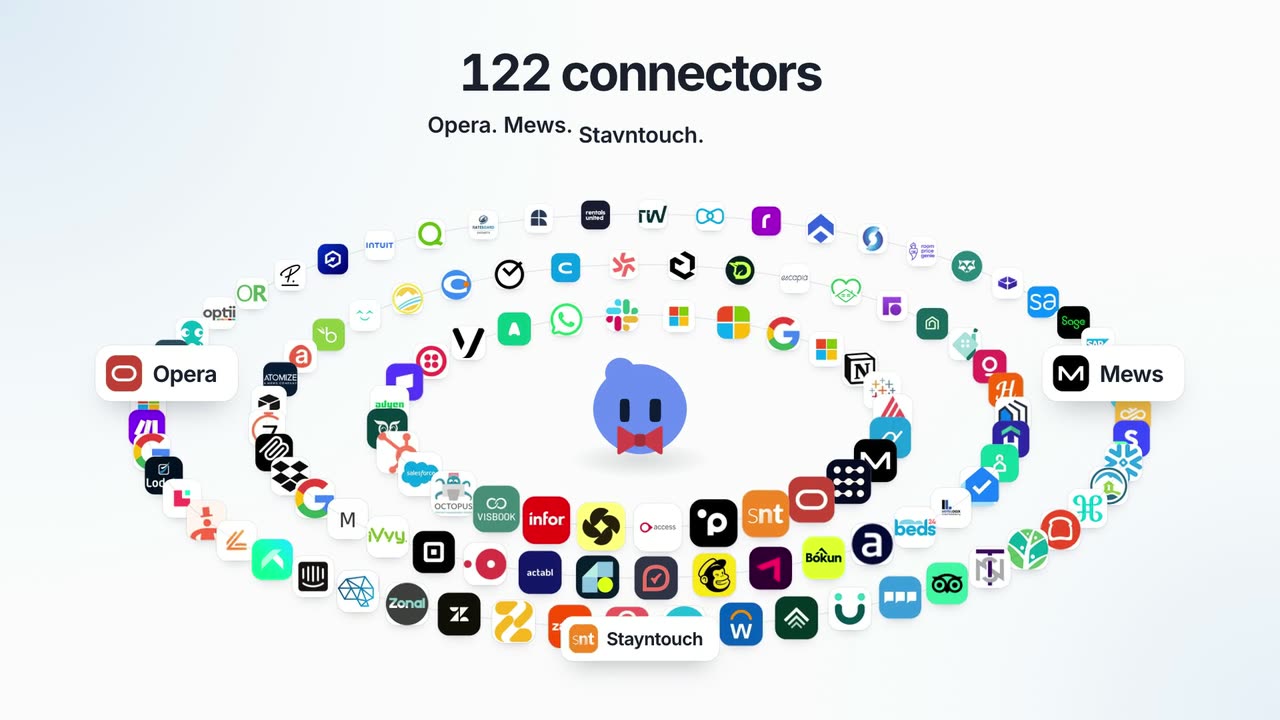
The difference is usually integration work. Some tools need a custom project for every system. Others come with ready connectors and actions, so the first agent goes live in days. For systems with no API at all, such as an extranet or a supplier portal, a browser agent can work the web screens the way a person would after someone signs in once.
How should you judge which tool is right?
Judge every tool by what it actually takes off your team, not by how good the demo conversation sounds. With that in mind, here are the tools worth knowing in 2027.
10 best AI tools for hotels in 2027
The right tool depends on the problem you are solving. Some tools are best at guest messaging, some at pricing, some at the guest journey, and one is built to run agents across all of it. Start from your biggest operational pain, not from the longest feature list.
Best practiceChoose where your agents will live first, then add specialists. If the layer comes first, every tool you add later follows the same rules and uses the same knowledge.
1. Venli
Venli is the agent management system for hotels. It connects to the PMS, mailboxes, CRM, POS and messaging channels a hotel already runs, and puts AI agents to work across front office, reservations, sales and events, operations and revenue. Each agent gets only the tools you give it, risky actions wait for a person, and everything is logged. Nothing is replaced: the PMS stays the system of record.
What does Venli take off a hotel team?
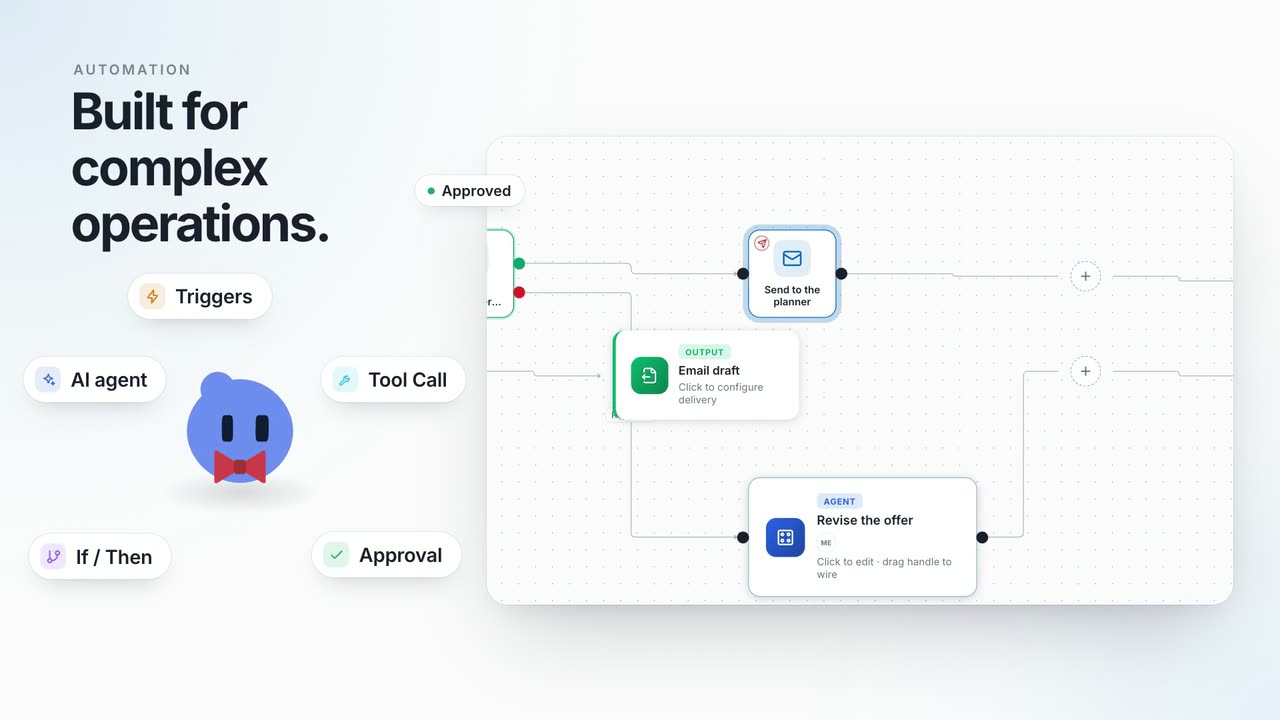
One guest inbox across email, SMS, WhatsApp, web chat and voice, with replies drafted from the booking. A MICE desk that reads group enquiries, checks what is missing, prices it from the hotel's catalogue, drafts the proposal and creates the deal. Background agents for the night audit, the morning briefing, shift handover and invoice processing, with 35 ready-made hotel automations to start from. And a copilot staff can ask in plain words: "show me tomorrow's arrivals with a balance over €200 and no card on file, and email me that list every morning at 7."
Why does it hold up when the hotel is full?
Because it is built for control. Every action is allowed, ask first or never. Cancellations, refunds and charges wait for a person by default, and rate changes always do. Agents are tested on the hotel's own data before guests see them, and every tool call is logged with who did what and the outcome. Data is hosted in the EU and is never used to train models.
Best fit: independent hotels and hotel groups that want AI across the whole operation, under one set of rules. A typical property is live within days. Plans start at €99 a month, billed on usage rather than seats.

2. Conduit
Conduit is an AI guest communication platform built for hotels. It brings guest conversations into one place, answers routine questions with AI, and routes requests such as towels, late check-out or maintenance to the right team with the conversation attached. It also offers voice AI for phone calls and spots upsell moments inside conversations.
Best fit: hotels whose biggest pain is guest message volume.

3. Canary Technologies
Canary is a guest management suite covering digital check-in and check-out, contactless payments and card authorisations, upsells, AI guest messaging and AI voice. It is widely used by branded and franchised hotels, particularly in North America, and publishes regular research on AI adoption in hospitality.
Best fit: properties modernising the full guest journey from booking to departure.

4. HiJiffy
HiJiffy provides multilingual conversational AI for hotels. It answers guest questions and assists with bookings on the website, WhatsApp and social messaging, and sorts conversations by topic so they reach reservations or the right department. It is popular with European hotels that serve an international guest mix.
Best fit: hotels that need guest support in many languages.

5. Asksuite
Asksuite is an AI reservation assistant focused on direct bookings. It answers enquiries with live rates and availability, works across website chat and messaging apps, and follows up on leads that did not book, with the goal of converting interest before it drifts to an online travel agency.
Best fit: hotels focused on growing direct bookings.

6. Duve
Duve is a guest experience platform that lets guests manage their stay from their phone: online check-in, preferences, a web-based guest app, automated messages through the stay and well-timed upsells. It works for hotels as well as apartments and serviced accommodation.
Best fit: hotels building a self-service, contactless guest journey.

7. IDeaS
IDeaS, a SAS company, is one of the longest-established revenue management providers in hospitality. Its systems forecast demand by segment from booking pace, seasonality and events, and recommend rates and restrictions, with group pricing and function space tools for larger properties.
Best fit: larger hotels and groups with a dedicated revenue team.

8. Duetto
Duetto is a cloud revenue strategy platform known for open pricing: pricing each segment, channel and room type on its own terms rather than moving everything from one best available rate. It combines forecasting with market signals and adds reporting and group pricing tools.
Best fit: commercial teams that want granular, segment-level pricing.

9. Lighthouse
Lighthouse, formerly OTA Insight, provides market intelligence for hotels: competitor rate shopping, parity monitoring, demand data and benchmarking, with pricing tools that turn market data into recommendations.
Best fit: commercial teams that price against the market every day.

10. Revinate
Revinate is a guest data and direct revenue platform. It merges guest profiles from the PMS and other systems, runs segmented email marketing, provides reservation sales tools, and offers Ivy, its AI for guest messaging that draws on past stays and preferences.
Best fit: hotels building direct revenue from guest data.
Choosing the right AI tool
No single tool fits every hotel. If guest messaging is the pain, a communication tool can fix it. If pricing is the pain, a revenue system will. If the pain is that work keeps falling between systems and departments, the answer is a layer that runs agents across them, with specialists connected underneath.
How do you know which tool will pay back?
Buy to fix a named problem, not because AI is expected. Good targets are measurable: reply time on the reservations inbox, time from group enquiry to proposal, hours spent on the night audit, enquiry conversion, and work handed back to the team. If a vendor cannot say which of these they will move, keep looking.
What happens in peak season without automation?
When the hotel is full, everything arrives at once: transfer requests, restaurant bookings, invoice questions from companies, group rooming lists, guests who want to extend. Replies slow down, satisfaction drops, and upsell and sales opportunities quietly disappear. Peak weeks are exactly when agents that handle the first pass, and hand over the rest with context, pay for themselves. Choosing a tool is half the decision. The other half is knowing which work to give it first.
The hotel AI use cases with the highest return
The best returns come from work that is high in volume, repeats every day and follows the hotel's own rules, while people keep the judgment calls. That is also where the gap between adoption and strategy shows: 78% of hotels use AI, but 78% have no formal plan for where it should go.1
The reservations and info inbox
This is the best first agent for most hotels. The AI reads every email, sorts it, looks up the booking and writes the reply as a draft that a person checks and sends. Venli's warm-up reads the hotel's past enquiries first and replays held-back emails, so the team sees the drafts it would have written before anything goes live.
Group and event enquiries
Group business is where speed wins deals. An agent on the sales mailbox reads each enquiry, checks what is missing, prices rooms, space and menus from the hotel's catalogue, and drafts the reply and the proposal for a coordinator to send. On Monday at 08:00 the Director of Sales opens a dashboard that shows three options expiring this week, two proposals unopened after five days and four events delivered but not invoiced.
The morning briefing and the night audit
Every weekday at 07:00, an agent reads today's arrivals, picks out VIPs and special requests, writes a short brief per guest, creates housekeeping tasks per room and emails the front office manager a digest. Overnight, audit checks flag folios that do not balance and rates that do not match before the morning shift arrives.
In-stay requests across every channel
Mid-stay requests such as towels, a broken kettle, a late check-out or a restaurant table used to pass from the desk to the right department by phone. An agent can answer on the guest's channel, create the task for housekeeping or maintenance, and close the loop with the guest when it is done.
Portfolio reporting for hotel groups
Groups often run different PMSs in different hotels. Copying each hotel's data into one clean store gives the group one set of numbers. A commercial director can ask "RevPAR last weekend across our Berlin hotels against last year, and which one dragged it down?" and get the figure, the comparison and the reason in one answer.
Why connect use cases instead of buying a tool for each?
Hotels often judge each AI tool on one number, hours saved or revenue gained. The best setups deliver both because the agents share the same knowledge and systems. The agent that drafts a guest reply can also check the booking, see the open balance and add the note for the night audit. Getting there takes more than the right features. It depends on what makes a tool effective in the first place.
What makes a hotel AI tool actually effective?
What separates useful hotel AI from the rest is not how fluent it sounds. It is whether it removes manual work, gets the facts right and shows results you can measure. That means connecting to reservation data, triggering real work and helping staff finish tasks rather than adding a screen.
TipIn every demo, ask the vendor to show a piece of work that disappeared from a team's day. A better conversation is not the same thing.
Does it know your hotel?
General AI understands language but not your property. "Can I bring my dog?" needs the pet policy, which rooms allow pets, the fee and whether housekeeping needs notice. An effective tool answers from the hotel's own knowledge: documents per property, house rules, procedures and even how each person writes. That knowledge should be versioned, with a person approving every change.
Can it read and write to the PMS?
The PMS holds reservations, room status, folios and guest preferences. Without access, AI cannot confirm an arrival time, check availability or tell whether a guest qualifies for an upgrade, so every question ends with a staff handover. With read and write access through the PMS's own API, AI moves from the conversation into the operation.
Does it start work, not just conversations?
Answering is the floor. Take a group enquiry for 24 people in March. An effective agent reads the email, checks dates and space, prices rooms and the meeting package from the catalogue, drafts the proposal, creates the event in the sales system and puts the draft in the coordinator's queue. That is six steps from one email.
What do disconnected systems cost?
Without that, the same enquiry passes through four people: one reads it, one checks space, one builds the price in a spreadsheet, one writes the email. Each handover adds a day and a chance to drop something. The cost is not only hours. It is the deals that go to faster competitors.
Can you control what it does?
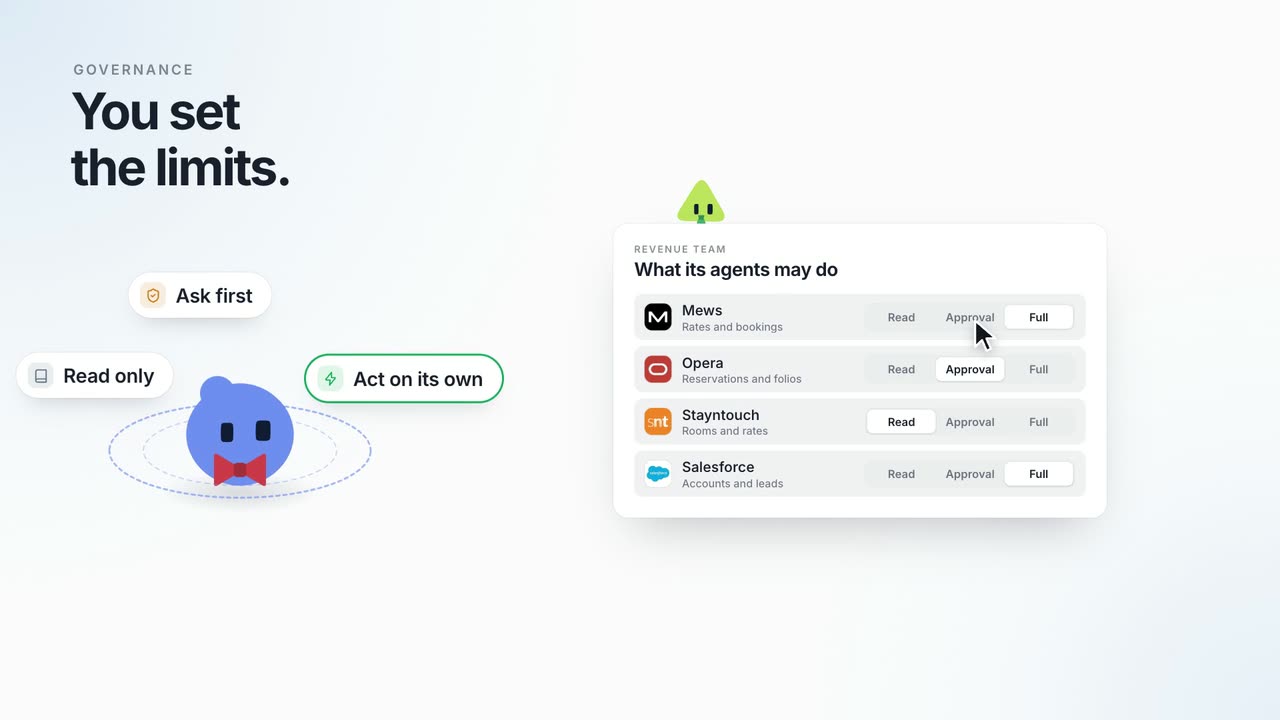
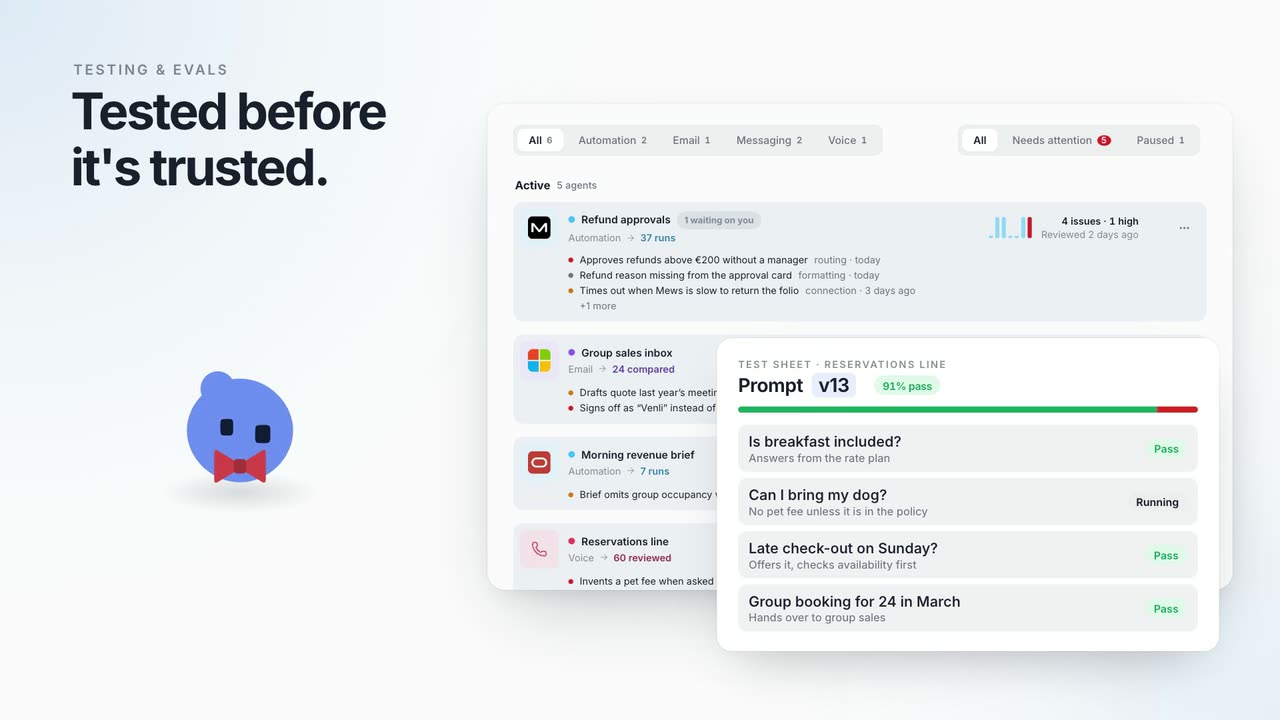
This is the question that decides whether hotels let AI act at all. Effective tools let you choose, per system and per action, whether an agent may act, must ask first or may never act. They hold any send after an agent has read outside content, as a guard against manipulation. They log every action with who, what and the outcome, and they let you test an agent on your own data before guests see it.
Does it keep the conversation together across channels?
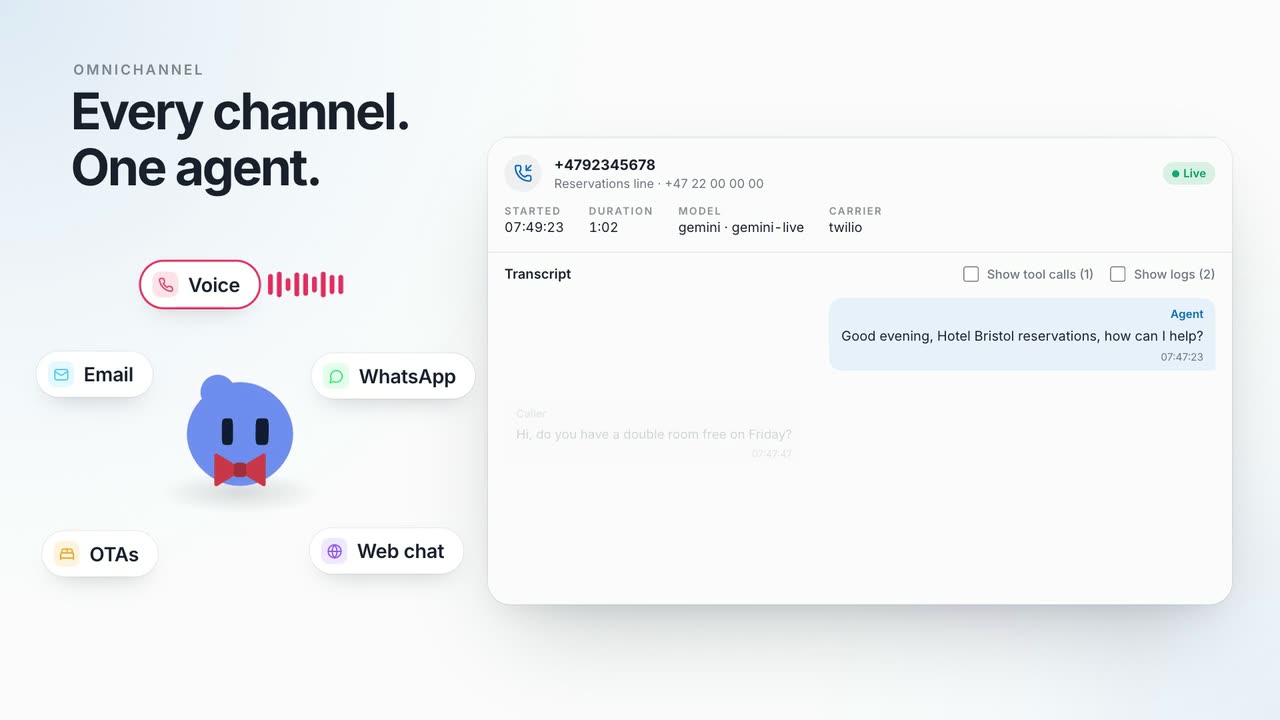
Guests move between channels. A question about parking on web chat, a request for early check-in by WhatsApp an hour later, and a call the next morning are the same guest and the same booking. Effective tools recognise that, keep one thread, and answer consistently wherever the guest writes or calls.
How hotels should evaluate AI vendors
Which of our systems does it connect to directly?
Ask which systems connect natively today, and treat "coming soon" as no. The PMS, inboxes, CRM, POS and messaging channels need direct connections, or the AI creates work instead of removing it. Ask too what happens with a system that has no API.
What work can the AI finish on its own?
Look past the conversation. Can it move a booking? Create a housekeeping task? Draft a group proposal with real prices? Prepare the night audit? The difference between executing work and answering questions decides whether you gain capacity or just another channel to watch.
What happens when the AI cannot handle something?
No AI covers everything. VIPs, billing disputes and unusual requests need people. Good tools hand over with the full history so the guest never repeats themselves, and pause the AI on a thread once a person takes over.
What may it do without asking, and who decides?
Ask to see the permissions: per system, per agent and per action. Ask which actions always wait for approval, and whether rate changes can ever run without a person. Ask where the log of every action lives and whether you can export it.
What results will you measure with us?
Judge outcomes, not features. Ask how the vendor measures reply time, the share of work handled, enquiry-to-proposal time, conversion and hours returned to the team. If the only numbers on offer are message counts, that is activity, not impact.
Where is our data, and who trains on it?
Ask where data is hosted and whether it is used to train models, and get the answer in the data processing agreement rather than a slide. For European hotels, ask how the vendor supports the EU AI Act, including a register of the agents you run.
How Venli puts AI to work across hotel operations
Answering questions is the easy part. The hard part is connecting those answers to the work behind them: the booking change, the proposal, the task, the check. Adding one more isolated tool usually means one more inbox. Venli treats every agent as part of one operation, sharing the same knowledge, the same systems and the same rules.
Key insightHotels do not need more AI tools. They need one place to run the AI they have, and to add agents without adding chaos.
One inbox for every guest conversation
Email, SMS, WhatsApp, web chat and call transcripts arrive in one unified inbox, where staff and agents work the same threads. A guest asks on WhatsApp to move their booking a day. The reservations agent sees one approval card with both the PMS change and the reply, and approves them together.
Why generic AI falls short in hotels
Generic AI treats each message on its own. Hotel work needs the whole picture: the booking, the house rules, room status, the guest's history and what the request means for housekeeping or the kitchen. Venli's company brain holds that knowledge per property, versioned and approved by people, and every agent and channel uses it.
Connected to the systems you already pay for
Venli reads and writes through each system's own API, with ten PMS connectors including Opera Cloud, Mews, Apaleo, Protel and Cloudbeds, plus mail, CRM, POS and messaging. Where there is no API, Venli can connect a system's own MCP server, call its API from a flow, or use a browser agent. Nothing is migrated and the PMS stays the system of record.
Agents for every department
Front office gets a copilot and the morning briefing. Reservations gets drafted replies. Sales gets the MICE desk and enquiry-to-proposal automation. Operations gets scheduled checks and the logbook. Groups get one set of numbers across every hotel and PMS. Each department adds agents on the same foundation instead of buying another tool.
How staff and agents work together
Staff can step into any thread at any time, and the agent steps back. Agents handle the routine; people take complaints, VIPs and anything sensitive. Teams teach agents house rules in plain words, and every change is confirmed by a person. The result is less copying between systems, more consistent replies and fewer things dropped in a busy week.
See Venli on your own systems
The fastest way to judge any hotel AI is to watch it work on your own data. Book thirty minutes with us, no deck. Bring one real case, a reservations email, a group enquiry or the check your team runs every morning, and we run it on your own systems.
TipBring your hardest case, not your easiest. A tool that handles your messiest group enquiry will handle the rest.
Sources
- h2c, Global AI & Automation Tech Report 2025, 189 responses from 171 hotels worldwide, via the sponsor's summary at suitepad.de.
- Canary Technologies, Navigating AI: Hospitality Shifts From Exploration to Execution (2026), canarytechnologies.com.
- RoomPriceGenie, 2026 State of Revenue Management Report, 450 senior revenue decision makers, as reported by Hospitality Net.
Venli publishes this guide and lists its own product first. Other tools are described from their public positioning as of October 2026; none paid to be included. Company logos are trademarks of their owners and are shown only to identify each product.
Venli is the agent management system for hotels, helping independent hotels and hotel groups across Europe run AI agents on top of the systems they already use.